Why weather belongs in your footfall analysis
Footfall counts the people who walked through your location. Weather explains why they came, why they stayed away, and why the same site can behave completely differently from one hour to the next. So let’s be clear: weather isn’t a “nice extra” in your reporting. It’s part of the commercial context and ignoring it leads to the wrong call.

Alberto Rodríguez Pariente, Data Analyst

Picture a site that looks weaker than last year. Add the weather, and the story flips. A rainy afternoon, a sudden cold snap, sunshine giving way to heavy cloud, each one changes how people behave, and it changes it fast. Weather shapes both whether people travel to you and what they’re in the mood to buy once they arrive.
For commercial teams, this is where numbers without context become dangerous. A drop in traffic isn’t always a trading problem. Sometimes it’s just the weather. Layer weather into the analysis and your report becomes more credible, easier to read, and far more useful when you have a decision to make.
Weather sharpens your benchmarking too. Comparing one store with another, or this week against the same week last year, is only fair when the conditions outside match. With weather in the picture, you can separate structural performance from short-term noise, and tell whether a site is genuinely underperforming or simply having a wet Tuesday.
That’s what makes weather analysis so valuable for forecasting, staffing, promotions and location strategy. It turns footfall reporting from a record of what happened into an explanation of why it happened.
See what the data tells us
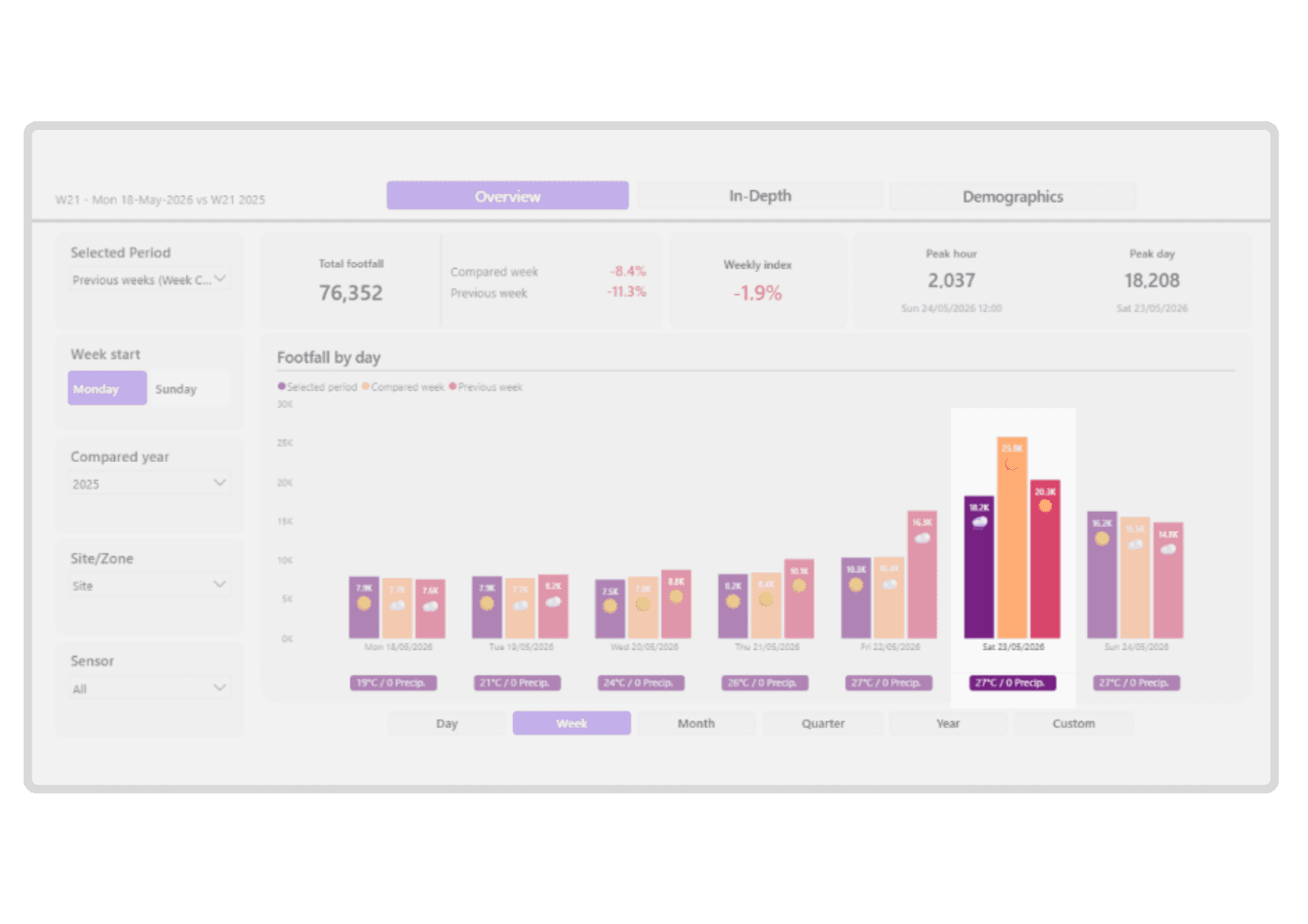
In the screenshot below, footfall drops on a given day compared with the same period last year. At first glance, it reads as a trading decline. Add the weather and the picture clears instantly: last year was sunny, this year was rainy.
This is exactly where weather data earns its place. It explains temporary variation, stops you overreacting to a short-term dip, and gives you a realistic read on how a site is actually performing.
The research backs it up
This isn’t a hunch. Researchers from IESE Business School and the University of Navarra analysed two years of daily data from 98 stores across 13 European markets. Their finding: weather affects both footfall and sales, but the effect depends on store type and product category. On a fully rainy day, footfall fell by around 7.4% in street stores, while shopping mall stores saw an increase of roughly 5.2%. Temperature moved the till too: a 5°C rise lifted dress sales by about 11% and cut coat sales by about 9%.
Weather impact shifts per location
Other work points the same way. A UK study by Rose and Dolega found weather consistently influences retail performance, though the impact shifts by location. High streets proved especially sensitive to rainfall, while enclosed shopping centres often benefited from bad weather as shoppers headed for cover. The effects were stronger in dense urban areas such as London than in car-dependent locations. This is a reminder to always read performance against local conditions.
'Seasonal effects in disguise'
Not every product reacts the same way. Research by Dimitrov, Chenavaz and Escobar showed that many “weather effects” are really seasonal effects in disguise. Once you account for normal seasonal patterns, only some categories show a genuine response to daily weather. Seasonal clothing, outdoor products and certain food and drink categories stayed highly weather-sensitive; everyday groceries barely moved. The lesson: analyse weather alongside seasonality, never in isolation.
Click & Collect
More recent research has turned to Click & Collect. A 2024 study found weather has far more impact on the day a customer places an online order than on the day they collect it. Poor weather nudges shoppers to order online rather than visit a store, while collection behaviour changes much less: they’ve already committed to picking up. In other words, bad weather often shifts behaviour across channels rather than simply switching demand off.
Put the studies together and they all land in the same place. Weather is not background information. It shapes where people shop, how many show up, what they buy, and even which channel they choose. Pair it with footfall data and you get the context that explains short-term swings, and the confidence to act on them.
The takeaway
Footfall data is at its most valuable when you read it in context. Weather is one of the most powerful external forces on customer behaviour, yet it’s the factor most often left out of the performance review.
Combine footfall and weather, and you can finally tell whether a change is down to trading or to conditions beyond anyone’s control. That means sharper benchmarking, more accurate forecasting, and real confidence behind every commercial decision.
Want to see what weather reveals in your own footfall data? Let’s talk.